
One-Page Bulge™️ UPDATES
As Steve Jackson and I work to complete the design, playtesting, and art for the second edition of One-Page Bulge™️ (OPB2), updates will be posted on the crowdfunding page and here on my LombardyStudios.com website.
ORDER OPB2 using the Shopify button at the bottom of this page
October 15, 2025
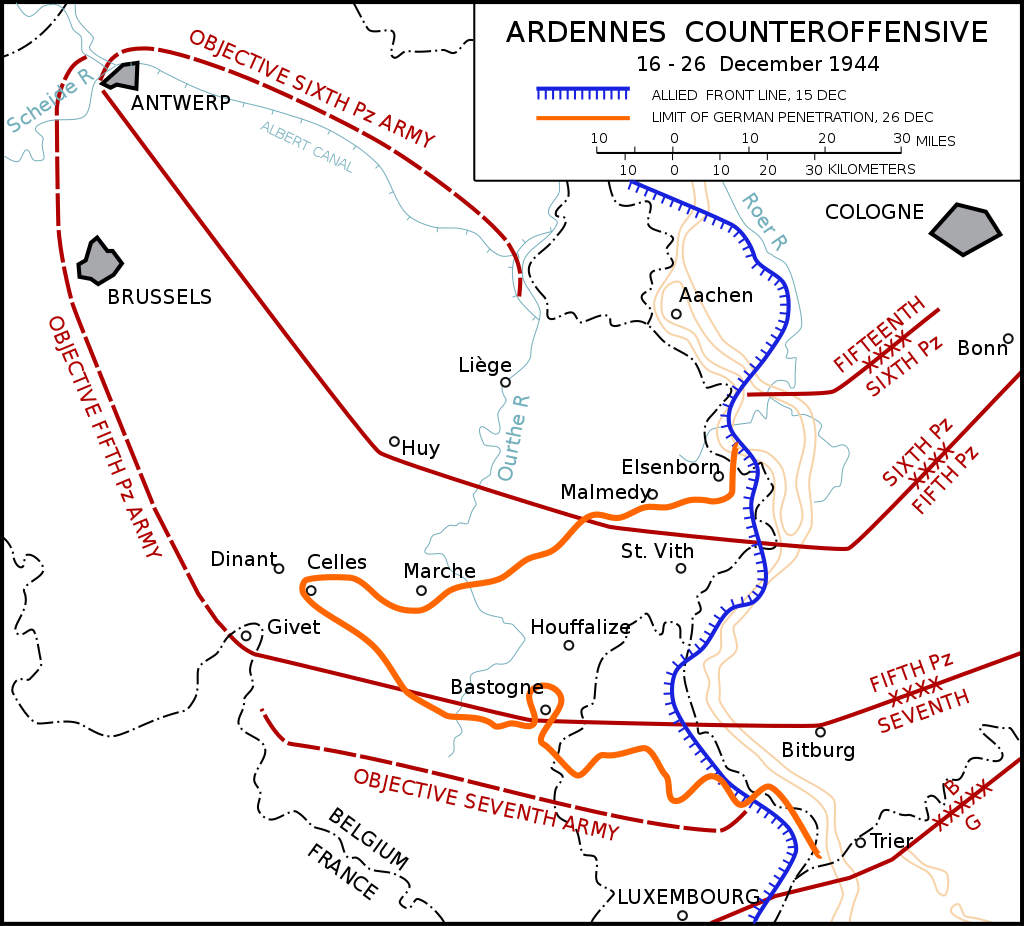
This map shows the German 1944-45 winter offensive plan codenamed Wacht am Rhein – Watch (Guard) on the Rhine. The German divisions assembling in early December to launch the attack were concealed through strict radio silence, bad weather that prevented Allied aviation from flying and searching for German units, and a prohibition on patrolling by these German divisions so the Americans would not capture prisoners that could alert them to these reinforcements.
Hitler assured his generals that the Americans were the weak partner in the Allied coalition against Germany and the six U.S. Army divisions in that part of the front would collapse from the surprise attack. The German armored and motorized columns in the Sixth Panzer Army’s 20-mile wide section of the front would drive 100 miles and capture the major seaport of Antwerp before the Americans and British could respond effectively.
This was an unrealistic plan that had little chance of success. The area that the German 10-day onslaught captured is shown by the orange outline. Steve’s original OPB displayed the territory of the battle from the December 16 front line to the Meuse River and the city of Liege. Simply reaching this river would have been a major accomplishment. This river line is the German victory goal of OPB and OPB2. See the original game map (below) next to the new map art that needs a hex pattern based on the revised turn/unit scale for OPB2 – the playtest map will be posted soon.
Good flying weather that began on December 23 plus the relief of the besieged U.S. forces at Bastogne on December 26 ended the German offensive. The Battle of the Bulge would continue until January 25 as massive American reinforcements slowly pushed the German divisions back to their starting line.
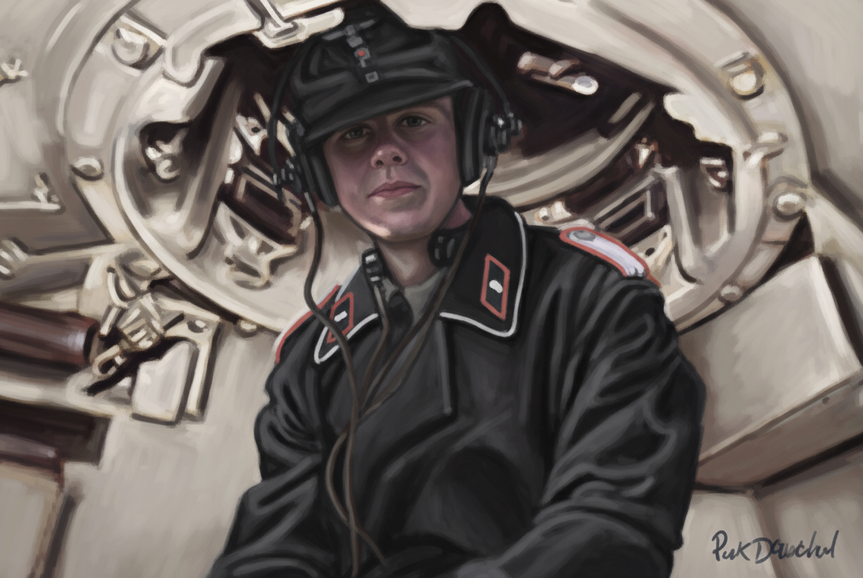
A third of all the U.S. Army divisions raised during World War Two – 31 divisions – saw action in this battle. The Sixth Panzer Army used four veteran Waffen-SS panzer (tank) divisions to attempt the breakthrough to Antwerp. These fanatical Nazi units had been mauled by the U.S. Army, Canadians, and British forces during the Normandy campaign and retreat to Germany. By December 1944 these four divisions were rebuilt with replacement tanks, weapons, and equipment, but many of their most experienced soldiers were eliminated. (Note the young German tanker in the custom-made art created for the illustrated historical guidebook.)
More backstory to come.
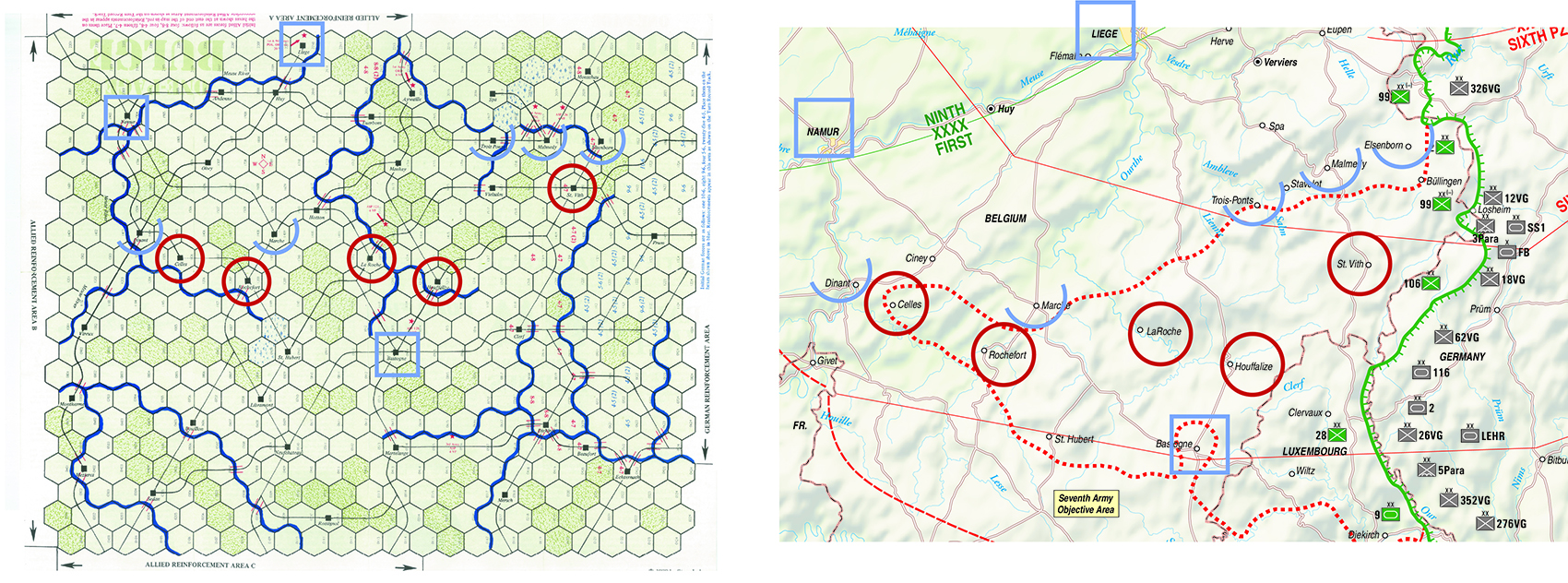
Original One-Page Bulge™️ game map (left) and new OPB2 game map in development (right). Key towns captured by the Germans are shown in red circles. Towns held by the American defenders are shown by blue squares and blue half circles.
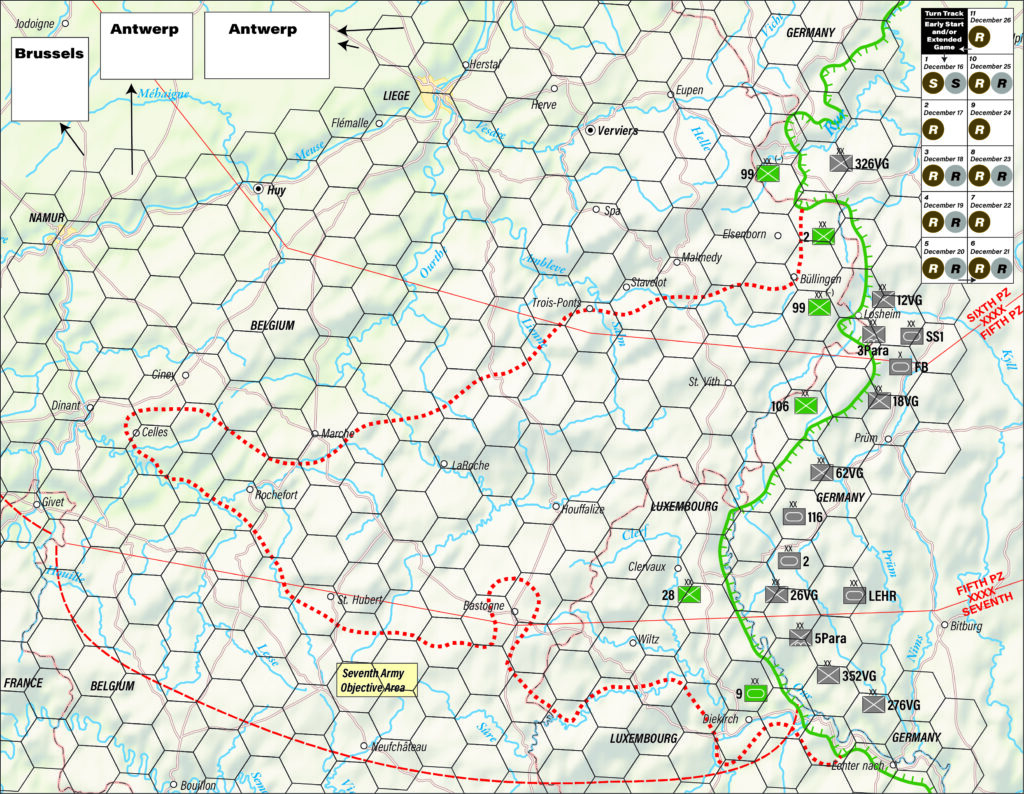
February 23, 2026: The playtest map is nearly done.
- The German and American units shown here will not be on the final game map. They appear only for historical reference in this update.
- The dotted red line represents the historical high-water mark the Germans reached. It will be on the final game map so players can see how well they perform compared to the historical outcome.
- To make it easier to identify river hexes all of the river thicknesses were increased and the rivers and roads no longer go along a hex line but are completely inside a hex. Rather than show all of the forested area which dominated the Ardennes region, we are working on how to best graphically represent the (far fewer) open areas on the game map. Snow and forests were everywhere so we want to keep the basic white color for all of the hexes. Hex numbers are being added next.
- The German objectives of Antwerp and southern flank protection area around Brussels are represented by boxes at the top of the game map. Different German victory levels are determined by moving German units into these boxes: the number of German units; the types of those units; and which boxes. Victory points will be different for each box.
- The Turn Track shows the 11 original turns of the game (December 16 through 26). Starting units and reinforcements are indicated by a circle with either “S” or “R” in them and a color – green for Americans, gray for Germans. We believe that a wargame should explore “what-if” possibilities: the basic historical game can begin sooner (with fewer German units) or go longer if the weather doesn’t clear when it did historically – thus delaying the massive Allied air support force multiplier that helped to stop the German offensive.
Sample unit counters, random event and tactical cards, and customized dice (being playtested) will be shown in the next several updates.